Documentary Footage

Connect with us on Facebook!

CAST YOUR VOTE!

Mission Statement

We are a non-profit organization dedicated to reducing violence by educating the public on negative effects of corporal punishment and promoting scientifically accepted, developmentally appropriate positive discipline.

The Last Resort is a documentary about the common practice of spanking children. With concern over domestic violence and bullying, and well published research on the damaging long-term effects of spanking, why do we still regularly hit our young children? Our film explores the idea that spanking teaches right from wrong and keeps kids out of trouble.  We have already interviewed youth in the juvenile justice system about how they were disciplined and what they think of spanking.  We will be interviewing experts in the field of brain development who have researched the effects of spanking on the child’s brain development.  We want to film Asadah Kirkland, an educator, who works with parents in the Harlem’s Children Zone.  We will film parents as they participate in an intensive parenting training program.  Parents reflect upon their own childhood experiences of discipline and sometimes violence to better understand their belief that violence is sometimes necessary to teach their children.

A Rampant Problem that Affects Most Children

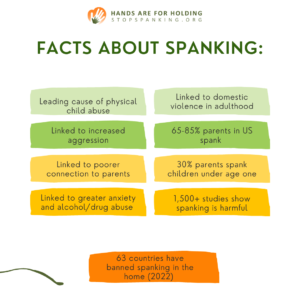
•    30% of American parents begin spanking when their babies are less than a year old
•    50% of all toddlers are spanked three or more times a week
•    94% of all toddlers are spanked

Spanking is the GATEWAY to Criminal Child Abuse

•    88 million Americans are physically abused as children
•    Parents who believe in spanking are 4X more likely to abuse their children
•    Most child physical abuse begins with physical punishment

Experts in the field of Childhood Abuse and Neglect conclude that ultimate control of the abuse problem lies in changing our societal attitudes towards and acceptance of aggression as appropriate mechanism for problem solving.   Many leading scholars have concluded that reducing corporal punishment is essential to reducing physical child abuse.  Our team of seasoned film makers, and experts in child development, neuropsychology, and juvenile justice are creating a documentary to examine the long-term effects of spanking children and why mothers rely on spanking as a last resort.

Please, Help Us Produce Our Film

ENDORSEMENTS

Rainbird Foundation
As an organization committed to the end of child abuse, we agree with the researchers who say that abolishing spanking from every state in the union is essential to ending child abuse. That our society still questions whether spanking is a form of violence is an absurd act of denial that contributes to the violence that children endure in this country. We think that your documentary is an elegant, efficient way to deal with this controversial subject. We wish you and your colleagues great success, and we will continue to find ways to support you and your film project.
Thank you for the work you are doing,
Hanna Roth, Founder,The Rainbird Foundation
 …
Dr. Vincent J. Felitti, MD, Co-Principle Researcher ACE Study, Kaiser and CDC
“While spanking or hitting relieves parental tension and sometimes immediately changes behavior, it does so by creating anxiety and fear. Creating anxiety and fear damages trust, attachment, and warmth between parent and child – a huge and unrecognized price that is charged to the future. Depicting these ideas subtly in a TV serial drama would help many people understand what doing better looks like.
I feel lucky because of spending several summers working on a farm as a kid. I was then, and still am, impressed by how well the animals treated their offspring. The cows never gored the calves, the pigs never harmed the piglets, the sheep never harmed the lambs, and the horses never kicked or bit the colts. They stuck with each other and they all grew up right. It was quite memorable.”
The Alliance to End the Hitting of Children

“Our mission  is to end all hitting of children at school and at home using educational. As such Robbyn Peters Bennett’s film project is such a fit for us that we have contributed financially to it . Robbyn is extremely energetic and ambitious about using film to address the myth that spanking is not any big deal. She is determined to show the link between spanking and permanently damaging physical and emotional abuse. This is crucial and foundational work in changing the culture that still believes in disciplining children through the obsolete methods  of fear and violence.

25 Responses to Documentary Footage

  1. Lisa King says:

    Robbyn,
    I am speechless. I am so incredibly proud and excited after watching this trailer. I am also sobbing for those children that have no voice. I am so grateful for all you have done for myself and my family. Mahlea still speaks of you and wants to play in your sand box! Mira is wonderful. I always KNEW that hitting my girls was wrong. I never have spanked. There has NEVER been anything so bad as to warrant it. What could possibly be that??. But I KNEW I just KNEW it was horrifying. It still scares me to think what may have happened in the past when visiting, mandatorily, their father. Thank you and your team for this.
    I shall continue to stay on top of your quest and if there is anything I can do to support this I am here… you have my number. So sincerely.. Lisa, Mira, and Miranda

  2. Paula Flowe says:

    Hi Robbyn,

    I love your website. I’ll be back to visit it regularly.
    Lots to see and learn!

    Please let me know if I can interview on our
    America Speaks Blog Talk Radio Show on
    childcare and training from birth to 3-years-old.

    Looking forward to hearing from you!
    Paula
    paulaflowe@thehittingstopshere.com

    • Laura says:

      As an adult, when you calmly plan out vienolce, it increases the severity of the charges (at least in the US). Why is it better to hit your child calmly’?I understand where the thought comes from we generally don’t like causing our children pain, so we rationalize our approach. Spanking in anger is retaliation, but if I’m calm, it’s for a long term gain. Parents may feel judged for spanking. I think most people who advocate absolutely no spanking are compassionate and understand no one is perfect. You feel bad and your child feels bad and there ARE other options. We don’t punish in our house, yet I’ve still hit my child. We all make mistakes. And hopefully I taught her something positive in how I handled it after I cooled down. Spanking is often seen as a last resort’ and to me, that just means you don’t have enough resources. My daughter is high-needs, strong willed, and very intelligent. A lot like me. I battled my parents constantly. They definitely felt the need to spank me. A lot. I don’t need to spank my daughter because I have different ways to interact with her. My mom has told me she wished she had known what I do now, because that’s how she would have done it.

  3. Al Crowell says:

    I am impressed with your documentary also and posted it on Movement for America’s Children. Also George Holden and a few others of us are in the process of gathering a roster of groups and people concerned about CP in US and Canada as part of a refional movement. I will get back to you about this as soon as it takes more shape. Al

  4. Nadine Block says:

    Robbyn, This is a wonderful documentary trailer. You have demonstrated in the trailer that you can tell a story extremely well and have available the expertise to put it into film in an exciting way. Best of luck to you in your important work! Nadine Block, Founder of the Center for Effective Discipline

  5. I was just going to say, “You need a Facebook ‘like’ button, because everyone should see this!” Great website, great idea, Godspeed to you!

  6. Lisa Butterfield says:

    I just wanted to comment on how well written this page is! I am pregnant with my first child and I personally do not believe in spanking. I especially loved the reference to how animals on the farm raise and care for their young….we can learn so much from nature and animals. I’m hoping my boyfriend will really understand and tak in what this website says! He believes in corporal punishment and for me I can not tolerate someone inflicting pain on my child! Hopefully more people will read this website and really stop and think before they abuse their child by spanking!

  7. Kelly says:

    Thank you for your work. I hope you receive your funding!

    “Spanking” is a special word we use to deny we are hitting people defenseless. It is an indefensible strategy. I didn’t believe in spanking either before I had children, and I had no history of violence. However I did begin to hit my children as I was raising them. I tried to stop but then I would snap and hit them again. There is a cost to the parent, not just the child(ren). I knew hitting my children was wrong but I didn’t think I could talk about it with anyone, my shame was so deep. Parents need a safe place to work out their troubles. I also think substance abuse, alcoholism, & addiction are major forces at play.

    Today I am a gentle parent and I support anyone who is working to advance the more humane, and less adultist, practice of caring for the child class. If there is any way I can help your endeavor, let me know.

    • Sergey says:

      Having raised 7 kids, this is dtnefiiely an issue we spent a lot of time thinking and researching about. It was a form of discipline I never felt comfortable with. My children actually received very few spankings in their childhood, and we have talked about it in recent years. I always viewed resorting to spanking as a failure in my parenting. Every time I ended up spanking my children, I apologized and told them how I should have handled the situation differently. I gave them permission to voice their feelings as well. We came up with a plan for next time so we both held a part in how to make changes. Even little bitty kids have great ideas and are often harder on themselves than I would have ever chosen to be!I think the real issue is when parents no longer have this tool when they choose not to use this they need concrete parenting ideas which work.It is very easy for an over whelmed parent to fall back on this because it is swift and usually effective in the short term. Many parents view no spanking as no discipline and then you end up with unruly kids!In the long run I feel it produces fear and anxiety in the child and that is counterproductive for building a good solid relationship into the teen years. I think most parents are trying to raise conscientious, well behaved, kind people and they may have religious or family views which support the idea of spanking being acceptable and preferred.I spent a lot of time researching biblical ideas on this and found a lot of myth and interpretation to be behind the proponents of spanking. Once I researched the science behind how it effects children, and other means of effective parenting, any and all spanking fell to the way side. Bottom line I think it is the worst type of tool in the parenting tool box and I want to do my very best for my kids!

  8. Mike says:

    Spanking is a reaction to behavior, which the child has elected to par-take in. Most often, children are warned many times over, and are even told they will get spanked……..if they do “it” again. When they do, they get spanked. It’s not something the parent decided to do. It’s something the child was willing to accept in exchange for some misbehavior he/she has elected to exhibit. That child has “Free will”, and has abused it. They KNEW what was coming if they acted that way.
    Spanking is NOT some parent loosing control and beating their children…….that isn’t spanking. that is child abuse. Spanking is an organized, systematic, rational approach to swift and stern discipline, designed to assist children, abrubtly stay the course, although only effective to a certain age……when they realize that the spanking is short term pain, and they would rather have that than long-term punishment.

  9. David Cooperson MA,MSW,LCSW says:

    As one who has worked in the child protection field for more than 30 years as well as being a family therapist,from experience I can say that it is necessary to follow the past three decades of powerful research that strongly stopping corporal punishment. Currently, unbelievably, there are 19 states where school physical punishment is still legal mostly with paddles and countless serious injuries have occurred mostly to the autistic and minority children. Congress is in denial about this issue and its Education and Workforce Committee is about to again ignore a bill to make this illegal.

  10. Anonymous says:

    You people are fools to say the least.

    I mean I was spanked when I was young
    (with a belt none the less and/or switch
    that I would get myself) I’m perfectly fine
    I grew up to be a well respected human
    being.

    I learned quick not to do wrong, but I don’t
    Hate or fear my parents I never did. Even if I did do wrong I knew that I shouldn’t have done that and that I would get a whipping(spanking) with a belt from my father.

    So I stopped doing what was wrong and started doing what was right. It wasn’t cruel or unjust and it sure as heck was not abuse I was loved and loved my parents back.

    I am not a people person yes but it is not because of spanking I was born this way and that is no lie. As a small infant I hated to be let down and cried when my mother would not hold me then as I became 2 and was a little more developed I would turn away from people who tried to speak to me I wanted nothing to do with humans so you can not blame me being antisocial on being spanked or “abused” as you fools put it.

    And as for the mental developement I as a 2 year old close to 3 years of age could take the hinges off the door and as a 4 year old I could do small equations and take apart small electronical devices and even take apart a small tv so I developed perfectly fine mentally even though I was spanked at a young age (I remember being spanked at such ages)

    Of course there is some people that are abusive with such things but there are some that are not. I don’t see the point in mindlessly spanking a child for something like how they made you look in public ex. They were a bit unruly or some crap like that but if say they stole something from a store or broke something on purpose I would see a spanking comeing their way and I don’t see the point of public spanking or yelling at the kid publicly it should be a household matter and dealt with upon returning to ones own home.

    I am a sixteen year old child that is well beyond her years in knowledge and surpass all my fellow students (when I try atleast a little bit maybe 5% of effort) and I get along great with others (when I want to) I’m amazing in art, music, math, science, ect. And I’m a teachers pet and get my work done in time and can be organized or unorganized when I want AND I was SPANKED and am PERFECTLY FINE. It was NOT ABUSE at ALL.
    It did NOT mess up my MENTAL STATE of MIND. And I WILL SPANK my own children if I have any in the futere no matter WHAT if I so see fit.

  11. Anonymous says:

    If 94% of toddlers are spanked, then how can you make the claim that parents who spank are 4x more likely to abuse their children……these two stats don’t make any sense together. Wouldn’t it stand to reason that if 94% of toddlers are spanked, then 94% of parents spank their toddlers…. If only 6% of children are not spanked as toddlers and 94% are spanked, it would stand to reason that there would be more children that are abused and spanked, then not spanked and abused. This is a bologna stat.

    • These statistics are peer reviewed and valid. However, I can understand your confusion. These statistics come from different studies. Yes, 94% of parents spank their toddlers, but many of these parents may have only done this once or twice, so spanking is relatively rare. And yet, 50% of toddlers are hit 3 or more times a week, so there are a lot of parents spanking a lot. Only somewhere around 50 – 65% of parents approve of spanking, so the 94% includes the times when parents that don’t believe in spanking do it anyway, probably because they are overwhelmed. Some parents do it once, and then feel sick about it and realize they never want to do it again.

      Parents who approve of spanking are 4X more likely to physically abuse their child. So, it is the 50 – 65% of parents who approve of spanking who are at greater risk. This isn’t hard to believe, considering that the Adverse Childhood Experiences Study (a longitudinal study of over 300,000 people over 15 years conducted in the state of Washington) shows that 29% of all respondents report they were physically abused (not just spanked) as children. That is over 88 million people.

      I know many, many children who have not been spanked, and by far they are the most well behaved children. Why? Because their brains are not being dysregulated by aggression, so they are more calm.

      • Anonymous says:

        You can make stats reflect anything you want….just look at exit polls. Sounds like a bunch of b.s. to me. Next month there will be a ground breaking study that says that feeding your children jolly ranchers will make them better behaved. Just google “pro spanking” and a thousand articles will come up stating that the stats you just quoted are inflated and completely untrue and another study found x, y and z. Being in the science field you should know findings = funding so of course these studies find exactly what they are looking for…..spanking = bad. Also, how scientific is it to combine studies….. You state these numbers come from different studies. The combining of these studies pushes the stats to a place that validates the position and agenda of those pushing the stats. The only children you can really speak to are the children that you LMHC and your CMHS degrees put you in contact with….every other child you are completely evaluating from the hip(terrible medical practice in general.) Any those children you come into contact with, can hardly coming to you because the are so well adjusted and have no social or mental issues. They’re not coming to you to socialize with you, I assume. So where do all of these children you “know” come from….? Also, putting your psych credentials after your name makes you sound like a pretentious jerk right of the bat.
        Dr. Mc Awesome, DDS, DMSSHTJI, FU

      • It must be tempting to be hostile, rude, and volatile when you are anonymous, particularly if you can’t handle your anger, which you clearly cannot. It is clear that you are reactive and unwilling to engage in respectful dialogue, and furthermore, you are not willing to actually read the research before you make all sorts of claims against it. The cumulative research is not controversial. It is scientific, it has been peer reviewed, and it is very credible – as credible as the science that warns of the risks for smoking. The controversy is not in the scientific community. Rather, it is between the scientific community and popular norm.

        Why does this topic make you so angry? Why are you so upset that we are defending a child’s basic human right not to be hit? Is it OK for me to hit you? Of course not. Why do you think it is OK to hit someone so much smaller than you in an effort to teach them. Teach them what? That you are bigger and you can hurt them? Not the lesson I want to teach the children I love.

  12. Anonymous says:

    P.S. guy in the documentary…..Your children are not your friends. They are your children. When they become adults, you have plenty of time for them to be your friends. Every kid I ever met growing up whose parents had that attitude of my child is my buddy, grew up to be a jerk and was a rude little brat.

  13. Gavin Bartlett says:

    Just as our adult interpersonal relationships are not ownerships, requiring clearly defined and totally respected boundaries, so do our relationships with our children. It is we as parents who have the responsibility to teach the child and encourage, influence it to establish its own health boundaries and the only way that we can do this effectively is by virtue of appropriate example, and then means our attitudes, tones of voice and actions must be seen by the child to tell the same story. Spanking is a violation of the innate biological phenomenon of empathy, as are many other symptoms of mankind’s dysfunctionality, which lead us to be less human than we delude ourselves to be. We are not born as a human being, we are born as a little ape called mankind, or homo sapiens that has to learn to be human and all that this status entails. Life teaches us its lessons with enough pain as it is, so why kick start that life for another, unique being over whose unique thought processes we can never exercise direct control with unnecessary brutality. Our job is to protect, nurture and positively influence the unique being into voluntary social responsibility, which encompasses responsibility for self and others, respect for self and others; caring for self and others without surrendering the unique self to anyone in the process.

  14. Fantastic work! Thank you so much for being part of the much needed change towards a violence free society where children are treated with respect and everyone recognizing that hurting a child in the name of discipline is false and dangerous thinking.

    Genevieve

  15. Robbyn, while I don’t have a problem with you drawing a distinction between legal and illegal, and even a common-sense distinction between causing immediate grievous bodily harm and delayed less-obvious harm, are you going to clarify your position on this page about spanking being “the gateway” to abuse?

    We both agree it is psychologically abusive, and further agree that through elevated stress hormones and other mechanisms — and perhaps more catastrophically still, damaging the child’s attachment to its caregivers which means the child cannot be effectively soothed from the physiological stress it receives both from the spankings as well as other negative events in life — that spanking is abusive.

    The parent may not intend it that way, but to the child it is abuse in the moment, even though the child will later rationalise it, itself a consequence of abuse.

    Similarly, a Muslim man following the advice of a fundamentalist Imam to use physical discipline on his wife may do so with the best of intentions (or a non-Muslim man receiving similar advice from his buddies), but society has evolved to the point where we see this as abuse.

    The fact that the law hasn’t caught up for children doesn’t change the fact that ethically and practically, spanking is abusive. Indeed, children can’t leave the situation, women usually can. Children didn’t choose to be in the relationship, women normally did. Women are generally only struck by one domestic partner, most children are struck by both parents if the family unit is together (and if it isn’t, you know that carries with it its own consequences).

    Correct me if I’m wrong, but if hitting women is abusive now that it’s illegal, it was abuse back when it was legal too.

    May I safely assume that’s your position regarding spanking of children?

    Finally, there is reason to believe that a less-than consistent anti-spanking message, one that doesn’t mention, “Never spank kids,” is unlikely to be very effective (p. 14-25). But when, “Never spank kids,” became the predominant message and law in Sweden, for example, despite a lack of actual criminal sanction, the percentage of parents believing it is OK to spank children reduced to a few percent.

    The work you’re doing is important and I appreciate your welcoming all opinions.

    • Dear Christopher,

      Your concern of having a clear, consistent message about spanking is such an incredibly important one. In my effort to show the link between spanking and reported child abuse cases, I can see that the message was confusing. I really appreciate your help in clarifying the message to keep it consistent and clear! Here is the formal position of Stop Spanking and abuse:

      We agree with Dr. Elizabeth Gershoff’s that, “The repeated finding that corporal punishment increases the risk for physical abuse is consistent with the notion of a continuum of violence against children that ranges from minor to severe. The evidence that corporal punishment and physical abuse are not distinct and are in fact variations of the same action toward a child is indisputable.” Stop Spanking concludes from the research that spanking is a form of abuse on the continuum of violence against children.

      Here is the post addresses the connection between spanking children under age one and severe child abuse cases resulting in hospitalization and even death. http://stopspanking.org/2013/04/16/more-children-under-age-one-are-hospitalized-from-physical-abuse-than-from-sids/

      Thank you Christopher.

      Robbyn Peters Bennett, LMHC
      StopSpanking.org

  16. Beth Love says:

    This footage is very well done and the topic is close to my heart. I would love to see the United States follow the lead of so many other countries who have articulated in law that children are fully human and deserving of the most basic right to not be hit. I do home your full length film will contain families and experts who are more ethnically and racially diverse than the “documentary footage.”

All Opinions are Welcome!

Fill in your details below or click an icon to log in:

WordPress.com Logo

You are commenting using your WordPress.com account. Log Out / Change )

Twitter picture

You are commenting using your Twitter account. Log Out / Change )

Facebook photo

You are commenting using your Facebook account. Log Out / Change )

Connecting to %s

Follow

Get every new post delivered to your Inbox.

Join 27 other followers

%d bloggers like this: